DVD Traumwerk


Jahrespreis der deutschen Schallplattenkritik 2008 read more


order through nosag records

 
  Jahrespreis 2008


Whoever wants to do dreamwork, must mix all things together.
Albrecht Dürer (1515)

The title Traumwerk or “Dreamwork”derives from Albrecht Dürer's description of his enigmatic and inventively playful “marginalia”, designed for the prayer book commissioned by the Emperor Maximilian in 1515.
The combination of a strange playfulness, its function as“marginalia”; like the labyrinthine imagery of the illuminated manuscripts it is a particularly inventive example of what Paul Klee was later to describe as “taking a line for a walk”. In some ways it is an exploration of “grotesquery” a free elaboration or rather an elaboration freed.
James Dillon

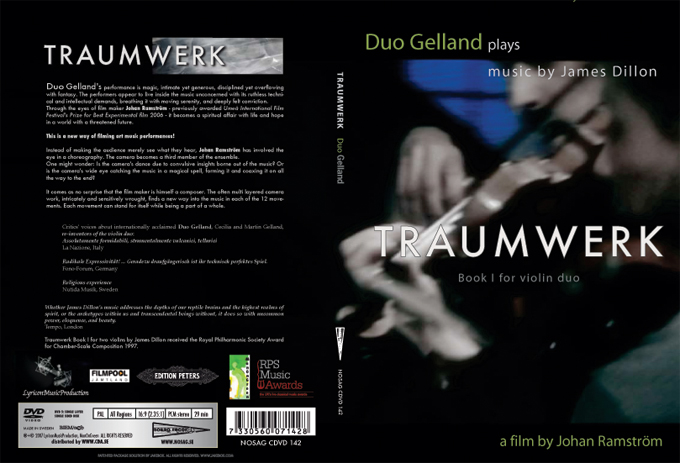
In this experimental art music video Duo Gelland performs in a concert-like situation for Johan Ramström's single camera. It's a performance that takes place in real time in a physical place. The performers stomp and breathe, yet instead of making the audience merely see what they hear, Johan Ramström has involved the eye in a choreography - literally taking the camera for a swirl about the church, accidentally even bumping into the performers - the camera becomes a third member of the ensemble.
One might wonder: Is the camera's dance due to convulsive insights borne out of the music? Or is the camera's wide eye catching the music in a magical spell, forming it, coaxing it on all the way to the end?

Traumwerk's 12 movements - filled with polyrhythms and microtones - are vivid visions with strong inner life and powerful emotional identities. This became even more evident as Duo Gelland played the music for school children and asked them to talk about what they heard and experienced. The children's startling comments were keen and insightful, relating complex structures of the music to their own worlds of dreams, fears and humour. The work with Traumwerk together with children of all ages was carried on for a few months. Through this dialogue, Duo Gelland gained a deeper understanding of the work, and also strengthened their conviction that today's art music can be a vital aid for one to grasp and form one's life in a complex world.

Johan Ramström
When Johan Ramström started playing the clarinet at twelve, music was only one interest among others such as film making and art. Music ultimately won Johan's main interest and, for many years, he earned his living as a freelance saxophonist playing jazz, blues and rock. In the early 90s, he realized that the excessive sound volumes on stage had caused him a permanent ear injury. This awoke an interest in "unplugged" music - orchestral music and chamber music. Beethoven, Anton Webern and Stockhausen all felt new and fresh. Johan started taking composition lessons and, in 2002, earned his Master of Fine Arts in Composition at the Piteå School of Music/Luleå University of Technology. His teacher was internationally renowned Swedish composer Jan Sandström.
In 2003, Johan Ramström was admitted to FST, the Swedish Composers' Society. Frequent work as a film music composer rekindled Johan's interest in film making. In 2006, Johan's film "THANKS", a collaboration with poet Peo Rask, was awarded the experimental film prize at Umeå International Film Festival. Traumwerk is Johan's first film as both editor and photographer as well as director.

James Dillon
Esteemed British composer of mostly orchestral, chamber, choral, vocal and piano works that have been performed throughout the world. James Dillon is self-taught as a composer. He had early experiences with traditional bagpipe music and in the late 1960s, he played with his band Influx. He studied at the Glasgow School of Art in 1968, linguistics at the University College of London in 1970 and piano with Eleanor Purse in 1970-71. Later, he studied acoustics at the University of North London in 1971, Indian rhythm with Punita Gupta in 1971-72 and mathematics with Gordon Millar of the Tavistock Institute in London in 1972 and attended computer music seminars at IRCAM in 1984-85.
James Dillon is closely associated with a number of the world's leading contemporary music ensembles. He has been a guest lecturer at many universities throughout the world, and was named Distinguished International Visitor by New York University in 2001-2002. In 2003 he was awarded an honorary doctorate by the University of Huddersfield. He is the first musician to receive 3 Royal Philharmonic Society Awards - Britain's most prestigious classical awards - for his work.
In 2007 he was appointed Professor of Composition at the University of Minnesota in Minneapolis/St.Paul. His works are published by Edition Peters, London.

Duo Gelland's performance is magic, intimate yet generous, disciplined yet overflowing with fantasy. The performers appear to live inside the music unconcerned with its ruthless technical and intellectual demands, breathing it with moving serenity, and deeply felt conviction.
Through the eyes of film maker Johan Ramström it becomes a spiritual affair with life and hope in a world with a threatened future.
Instead of making the audience merely see what they hear, Johan Ramström has involved the eye in a choreography. The camera becomes a third member of the ensemble.
One might wonder: Is the camera's dance due to convulsive insights borne out of the music? Or is the camera's wide eye catching the music in a magical spell, forming it and coaxing it on all the way to the end?
It comes as no surprise that the film maker is himself a composer. The often multi layered camera work, intricately and sensitively wrought, finds a new way into the music in each of the 12 movements. Each movement can stand for itself while being a part of a whole.

Whether James Dillon’s music addresses the depths of our reptile brains and the highest realms of spirit, or the archetypes within us and transcendental beings without, it does so with uncommon power, eloquence, and beauty.
Tempo, London

Traumwerk Book I for two violins by James Dillon received the Royal Philharmonic Society Award for Chamber-Scale Composition 1997.

home